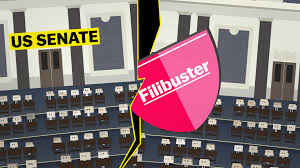
Is it time to retire the Senate Filibuster?
U.S. Politics July 31, 2020, Comments OffDuring the eulogy for civil rights icon John Lewis given by former President Obama he raised the topic of the filibuster, and the need to eliminate this draconian rule, which was put into place by Senators many decades ago in order to stifle any legislative progress on such bills as the civil rights act, etc.
In short, the filibuster allows a minority party to block legislation provided they have at least 41 seats in the 100 seat Senate as it would require a 60 vote count in order to pass legislation as opposed to a simple majority (50 votes + tie-breaking vote of the VP).
Originally it was enacted by the Senate back in 1919, which required a two-thirds majority to end debate, thus 67 votes, but in 1975 it was reduced from two-thirds down to three-fifths (60 votes).
Majority leader Sen. Mitch McConnell (R-KY) had previously warned his Democratic counterparts that eliminating the filibuster would be a mistake, as it would curtail the need by the majority party to compromise on bills as a simple majority would suffice.
Having said that, what are the pros and cons, and should it be eliminated?
From the left
For progressives there are two main reasons to eliminate the filibuster rule in the Senate:
- The rule was an effective tool used during the Jim Crow era to prevent civil rights bills from being enacted in Congress such as anti-lynching, voter rights, etc. Thus it’s seen as a racist rule and one that should be retired in today’s day and age.
- Very seldom has one party a super majority of 60 Senate seats, thus it makes it easy for a minority party member to block legislation, even if a majority is in favor of the bill. During the Obama administration it became mission impossible to get any legislation passed once the Democrats lost the super majority in the 2010 mid-term elections, and pretty much legislation came to a grinding halt. The same can be said today by the way for the Republicans.
From a negative point of view for the Democrats this may seem like a good change if they become the simple majority party in the Senate after the 2020 election, but to Sen. Mitch McConnell’s (R-KY) point – the party will not always have the majority in the Senate thus it may come to bite them when they don’t.
From the right
From a conservative point of view there are some mixed emotions about the filibuster. Former Republican Senator John McCain (R-AZ) said it best when he gave his infamous speech on the Senate floor before he passed away to point out that the Senate isn’t getting anything done.
Part of the problem, he pointed out, was that the parties aren’t negotiating with one another in good fate. The other part is that due to the filibuster rule it’s easier for a minority party to block and make noise about a bill they don’t like, versus being productive for the country.
Of course, on the other hand, without the filibuster it may become painful to be in the minority party as passing legislation would become easier, and the outcome may reverberate for decades to come without a chance of stopping it. The likes of Sen. Mitch McConnell (R-KY) would rather see compromise being forced on the majority party even if that slows down the pace of legislative action.
From the center
Maas Media feels that a filibuster increases the likelihood of needing to compromise with all parties, and it allows the minority party to be heard, and thus it pretty much guarantees that both parties get a majority of what they want in a bill.
However, due to the partisan divide over the past 30 years that picked up steam under the Clinton administration we have seen the Senate come to a grinding halt when it comes to producing legislation. In fact, we used to average over 700 bills being passed by congress during a 2 year term, but that number is now hovering around 300 and it keeps going down. The biggest reason is because bills keep dying in the Senate, not so much in the House as the House doesn’t have a filibuster.
Therefore, Maas Media feels strongly that the time of the filibuster needs to come to an end, and for the following reasons:
- It speeds up passage of legislation by removing the ability of one individual to block the passage of a bill.
- It still ensures that compromises need to be made because a majority of the time neither party (plus White House) has the majority. Therefore, it’s still possible for a President to veto a bill that in turn requires two-thirds of a vote to override in congress and historically fewer than 10% of all Presidential vetoes have been overridden.
- If the minority party doesn’t like the bills being passed then it needs to focus on recapturing the majority, but in a democracy the majority rule should apply for the greater good of the nation.
We welcome your feedback in the comments.
Author
